

AI Wisdom Volume 2: Meta-Principles of Interaction (upcoming)

I hope everyone had great holidays and are raring to go in 2026!
I’ve been working on finishing my book, so the other writing has taken a back seat. This post introduces the book and its underpinnings, along with it’s predecessor volume.
** Coming Soon **
AI Wisdom Volume 2: Meta-Principles of Interaction
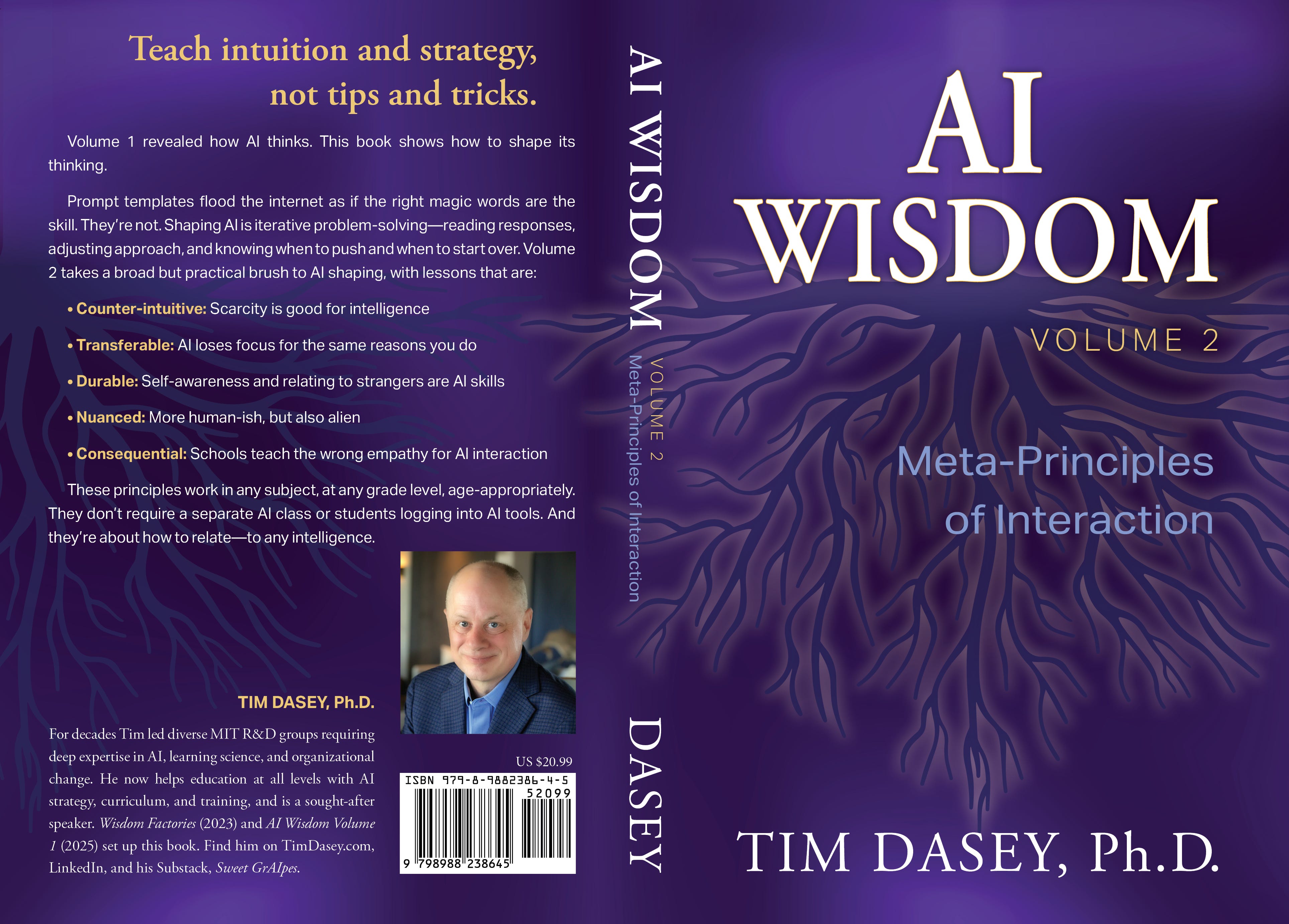
AI Wisdom Volume 2: Meta-Principles of Interaction is almost ready for publication.
The first volume was about how AI “thinks” and learns. This is about how to shape it.
I am taking a different tach then…well…everyone else? The durable core of AI education isn’t about using products. It’s about the skills we’ve always claimed matter—judgment, communication, problem-solving, collaboration, adaptability. And about something rarely addressed, for either AI or brains. All intelligences share common needs and have common challenges. Sometimes humans and AI approach them very differently, and sometimes they’re eerily similar.
These 21st-Century skills all clearly have discipline-specific versions. Judging art and a chemistry idea are not the same.
“AI Wisdom” is durable meta-knowledge about AI. But that meta-knowledge is often quite close to what we want to teach students anyway about their minds and interactions.
You don’t need every teacher to be an AI expert, or even to use AI, to learn the most important long-term aspects of it. It’s actually a small hop from teaching the meta-lessons you already teach. You can relate that meta-knowledge to AI too, or learn a new nugget that AI exposes that fits neatly into what you already know and already do.
There is another way.
What’s a Meta-Principal?
My goal with this book series is to lay out what’s durable about AI. What will be relevant in twenty years too. Most of that boils down to intuition about AI, what it might do, how it might be used, and how to maximize the good and minimize the bad.
These are similar skills to ones people need to have when approaching a stranger. The big difference is this “stranger” AI only sort of behaves like people. Knowing the difference is key.
But how do I describe gut feel? Some of that comes from conscious ingestion of knowledge that eventually becomes automatic, but even more is nebulous, barely lingual, and comes solely from experience. The best I can do is lay out heuristics, tradeoffs, and rules-of-thumb in a way that’s teachable.
I’m calling those nuggets “meta-principles,” but the explanation doesn’t fit well on an index card, so I’ll give an example.
Behavioral Patterns Over Labels: Observe what an intelligence actually does across situations rather than trusting categorical descriptions.
That’s an example from AI Wisdom Volume 2. The meta-principles represent intuitions I want people to have in AI interactions. Not the nuts and bolts “neuroscience” about AI, but the “psychology” of it.
This meta-principle says too often our expectations get in the way of observing “personalities”. The AI of yesterday clouds our perception of today’s. Each AI “stranger” needs even more nuanced observation than with people.
That intuition won’t expire when the next model drops. And most of them don’t require AI to teach. They’re often important in human relationships too, as this one is. They’re not taught by using AI on an assignment, or a memorized list of meta-principles. They’re durable skills taught by varied experience and reflection that leave the intuitive residue. Because in the moment you need to type into an AI interface, nobody’s going to go through a checklist. It needs to be baked in.
Meta-principles describe patterns that recur across different contexts and scales, abstract enough to apply broadly, concrete enough to shape judgment about when and how to act. They can be stated simply but can’t be fully understood through statement alone. The understanding requires experience, struggle, discovery through productive engagement with complex challenges.
As these volumes progress into more complex territory the meta-principles become more open to interpretation. There are many ways to characterize what makes interaction effective. My choices emphasize aspects where AI cognition diverges from human cognition in ways that trip people up. The principles aren’t arbitrary, but neither are they the only valid selection. They’re the ones I believe will remain useful longest and teach the deepest transferable skills.
Students learning these principles develop capabilities that transfer across domains. These aren’t AI literacy skills dressed up in fancy language. They’re fundamental capabilities for navigating complexity wherever it appears.
The meta-principles have few age restrictions. The challenge scales, but the underlying muscle is the same. They don’t require you or the students to use AI, though at more difficult challenge levels it becomes more useful. And they don’t require you to be an AI expert to teach them. Most meta-principles can fit into something you already teach.
There is another path. One that will last.
AI Wisdom Volume 1: Meta-Principles of Thinking and Learning
Amazon: paperback, hardcover, e-book
Other online retailers and book stores: paperback and hardcover (B&N link)
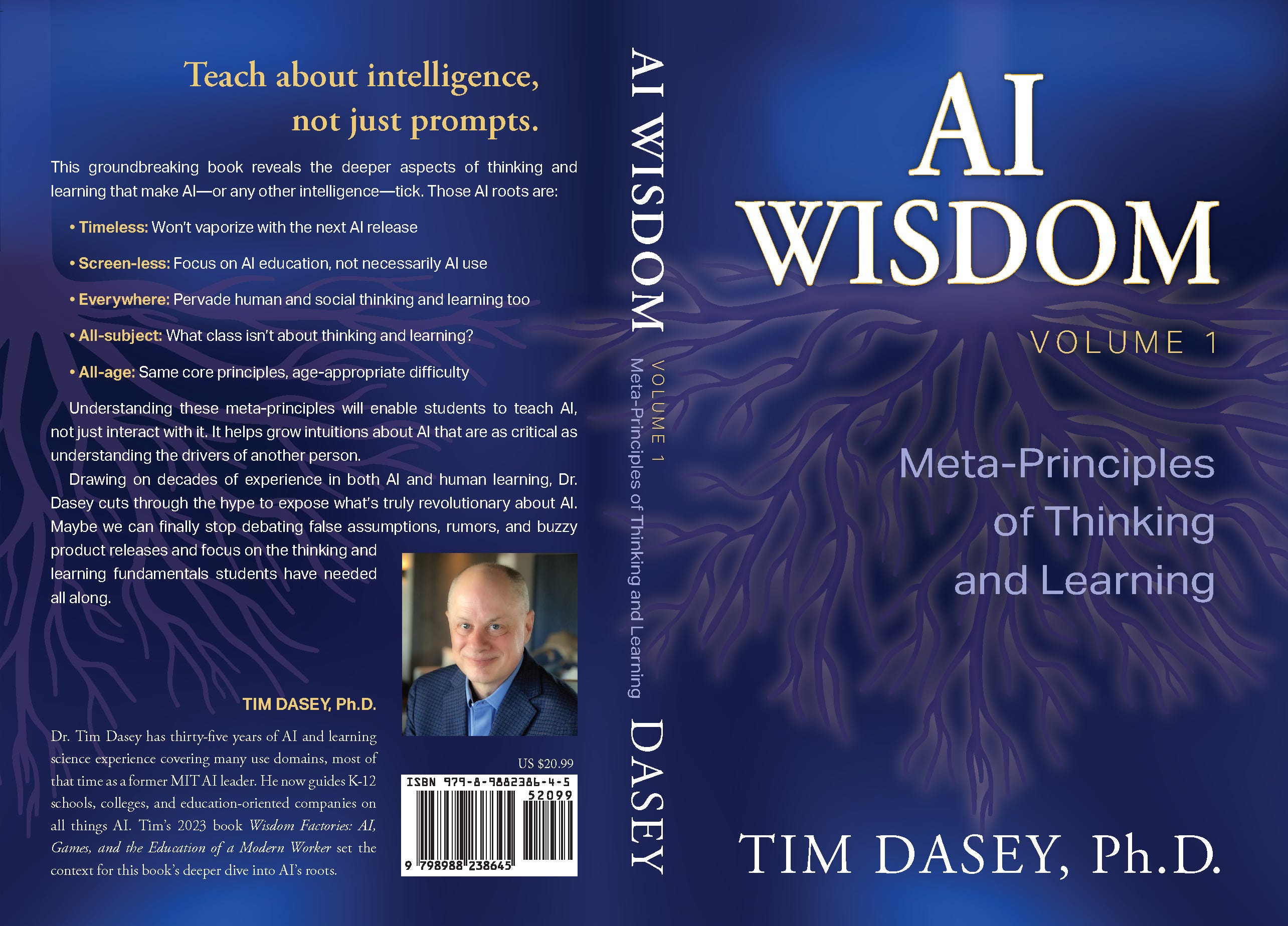
Teach about intelligence, not just prompts.
Durable AI literacy isn’t based on products and prompts, but on metacognitive aspects of thinking and learning. The benefits are huge: intuition about AI interaction and management, sizable cross-over to human and collective intelligence, and lessons that can be applied to any course, even without screens. Even the youngest students can learn AI’s meta-principles in age appropriate ways.
In this first of a two-part series, former MIT AI leader Dr. Tim Dasey answers the “What is AI?” question for educators, parents, and leaders. What makes AI tick is important knowledge for every AI use, and for each AI societal choice.
Tim draws on decades of experience, integrating knowledge of AI, neuroscience, psychology, and educational theory, all in an approachable way. He explains:
Why ant colonies, economies, and AI neural networks have design similarities
How AI really does “know,” including things its developers never expected
How AI learning methods reveal better ways to structure education itself
Why people and AI are creative because of nuanced concepts, not precise facts
How some AI biases and errors can be tamed
In understanding the AI roots, educators gain not just insight into a transformative technology, but a powerful new framework for teaching students about themselves.
Core Outline
Part I. Meta-Thinking
Chapter 1: Pattern Analyzing – How does sophisticated intelligence emerge from networks of simple components rather than explicit rules?
Chapter 2: Transforming – What are the fundamental ways that any intelligence converts information from one form to another?
Chapter 3: Knowing – Can AI truly “know” or “understand” anything?
Chapter 4: Conceptual – Why does AI excel at conceptual understanding while struggling with simple facts?
Chapter 5: Creative – What is creativity, and which aspects can AI or people do better?
Part II. Meta-Learning
Chapter 6: Learning – How do neural networks learn by optimizing toward goals, and what are the pitfalls?
Chapter 7: Adaptive – How can AI learn in dynamic environments where conditions change and actions have consequences?
Chapter 8: Data-Driven – How do the examples we show AI shape what it learns and how it responds?
Chapter 9: Erring – What kinds of mistakes does AI make, and how should we handle each type?
Chapter 10: Getting Started – How can educators practically teach AI meta-principles regardless of their technical background?
©2026 Dasey Consulting LLC
Glad to hear your part two!